
What Should a Business Network Design Proposal Include?
A business network design proposal should clearly define your current network, the recommended structure, security planning, implementation coordination, and documentation. Within any professional network infrastructure design proposal, these elements must work together as one structured plan. It must show how the design supports reliability, scalability, and ongoing support. When we review proposals, we look for clarity and accountability at every stage. If those elements are missing, risk increases.
Most businesses begin their search because something feels uncertain. They compare providers and try to determine which proposal reflects careful planning. We understand that confusion. A strong proposal removes it by explaining how each decision supports daily operations and long term stability.
Core Components of a Strong Proposal
Every serious proposal begins with a documented review of the existing environment. We start with an assessment because design without context leads to assumptions. The proposal should identify switches, firewalls, wireless coverage, bandwidth usage, and performance concerns.
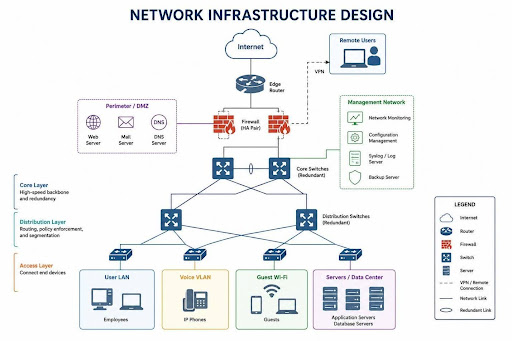
The architectural section must explain how the network will function each day. It should describe segmentation, access control, redundancy planning, and traffic flow within the overall network infrastructure design. A disciplined approach prepares the business for growth instead of forcing reactive upgrades later.
Security planning must be specific. We expect to see a defined firewall structure, monitoring approach, and data protection measures. General statements about security do not provide assurance. Clear definitions do.
Technology recommendations must include reasoning. We connect every equipment decision to operational needs so leadership understands the impact of each choice. Justified recommendations reflect experience and structured thinking.
What is the best video surveillance system?
The best video surveillance system depends on building size, risk level, and monitoring needs. We often see businesses benefit from IP based systems that integrate securely into the network and allow controlled remote access. The critical factor is integration. Surveillance must function within the network structure without affecting performance or weakening security controls. A proposal should explain how that integration works.
What Weak Proposals Often Miss?
We frequently review proposals that list equipment without explaining how the components support the overall structure. Some mention security but avoid describing segmentation or monitoring. Others overlook documentation commitments.
When clarity is missing, long term maintenance becomes difficult. Structured planning prevents these gaps before they create operational issues.
Implementation Coordination and Operational Stability
Careful buyers want to know whether the provider will manage change responsibly. A professional proposal answers this through visible coordination.
It should define project phases, scheduling considerations, configuration steps, and how operations remain protected during changes. We approach implementation as a managed process because network changes affect every department. Planning, deployment, and support must work together.
Clear coordination protects productivity and builds confidence.
Proposal Comparison Criteria
When comparing proposals, focus on structure and responsibility.
- Does the proposal clearly define deliverables?
- Does it explain architecture and security in simple language?
- Does it outline coordinated implementation planning?
- Does it confirm documentation and ongoing support?
If one proposal lists hardware while another explains planning, accountability, and documentation, the difference reflects depth.
Practical Checklist to Save
Before approving any proposal, confirm that it includes
- A documented assessment of your current network.
- A clear architectural explanation with segmentation.
- Defined security planning and monitoring.
- Justified technology recommendations.
- Coordinated implementation planning.
- Performance review and documentation commitment.
Each item reflects the structured approach described in our services.
Performance Review and Documentation
A proposal should explain how we will review the network after deployment to confirm it performs as intended. Defined review steps reduce uncertainty before final approval.
Documentation must include updated network diagrams and configuration records. Accurate documentation supports monitoring, maintenance, and ongoing IT troubleshooting services. Our services emphasize planning, implementation, monitoring, and support because networks require steady oversight.
Final Words
A strong proposal connects planning, deployment, monitoring, and support into one disciplined direction. At S5 IT Consulting, we combine experience, coordination, and ongoing service so you can move forward with confidence based on clarity, preparation, and long term stability.
Frequently Asked Questions
How do I compare network design proposals effectively?
Start by comparing structure, not just price. A solid proposal explains deliverables, outlines the architecture and security approach, defines implementation planning, and confirms documentation and support. If one provider only lists hardware while another explains how everything works together, the second proposal typically reflects deeper planning.
Why is documentation important in a network proposal?
Documentation keeps your network manageable after installation. A complete proposal should include updated diagrams and configuration records. These support monitoring, maintenance, and troubleshooting over time. Without clear documentation, even a well-designed network can become difficult to manage.
How can I tell if a network proposal is too vague?
A proposal is too vague when it lists equipment but fails to explain how the components fit together. It might mention security without describing segmentation or monitoring. When responsibilities, planning steps, and documentation are unclear, the proposal lacks the detail needed for confident decision-making.
What is the best video surveillance system for business use?
The best video surveillance system depends on your building size and monitoring needs. Many businesses use IP-based systems that connect securely to their network. Proper integration is critical. Surveillance should operate within the network without slowing performance or weakening security controls.
How do I compare network design proposals effectively?
Start by comparing structure, not just price. A solid proposal explains deliverables, outlines the architecture and security approach, defines implementation planning, and confirms documentation and support. If one provider only lists hardware while another explains how everything works together, the second proposal typically reflects deeper planning.
Why is documentation important in a network proposal?
Documentation keeps your network manageable after installation. A complete proposal should include updated diagrams and configuration records. These support monitoring, maintenance, and troubleshooting over time. Without clear documentation, even a well-designed network can become difficult to manage.
How can I tell if a network proposal is too vague?
A proposal is too vague when it lists equipment but fails to explain how the components fit together. It might mention security without describing segmentation or monitoring. When responsibilities, planning steps, and documentation are unclear, the proposal lacks the detail needed for confident decision-making.
What is the best video surveillance system for business use?
The best video surveillance system depends on your building size and monitoring needs. Many businesses use IP-based systems that connect securely to their network. Proper integration is critical. Surveillance should operate within the network without slowing performance or weakening security controls.